


~ A personal journey through Vienna’s cohousing projects
I had heard about cohousing before my volunteering with CoHousing Budapest began, but looking back, I have to admit that my understanding of it was quite limited. I imagined it simply as a group of people deciding to rent or buy a house together and share it. It seemed practical, maybe even a bit idealistic. But I was soon to discover that it is far more than that.
As someone who grew up in a post-socialist country, anything shared carries a particular kind of weight, as there is still a lingering memory of shared walls you did not choose, of a sense of community that was imposed rather than formed. Because of this, cohousing can sound a bit suspicious. Perhaps that is part of the reason it has never fully taken root here. To many people, it still feels like something associated either with activist alternative communities or with students who cannot afford anything better.
And yet, reality has a way of reshaping perceptions. Across Central European cities, the housing market is becoming increasingly difficult: housing prices are rising, square metres are shrinking, and more people are living alone in ways that are not really chosen. In this context, the idea of shared living begins to shift. Slowly, people are becoming more open to alternatives, reconsidering what “home” might look like.
Still, from the outside, the cohousing projects in Vienna seemed almost too good to be true – architectonically interesting, wonderfully located, good-quality buildings. So when the opportunity came to visit them in person, I went with a mix of excitement and skepticism, but having a head full of questions.
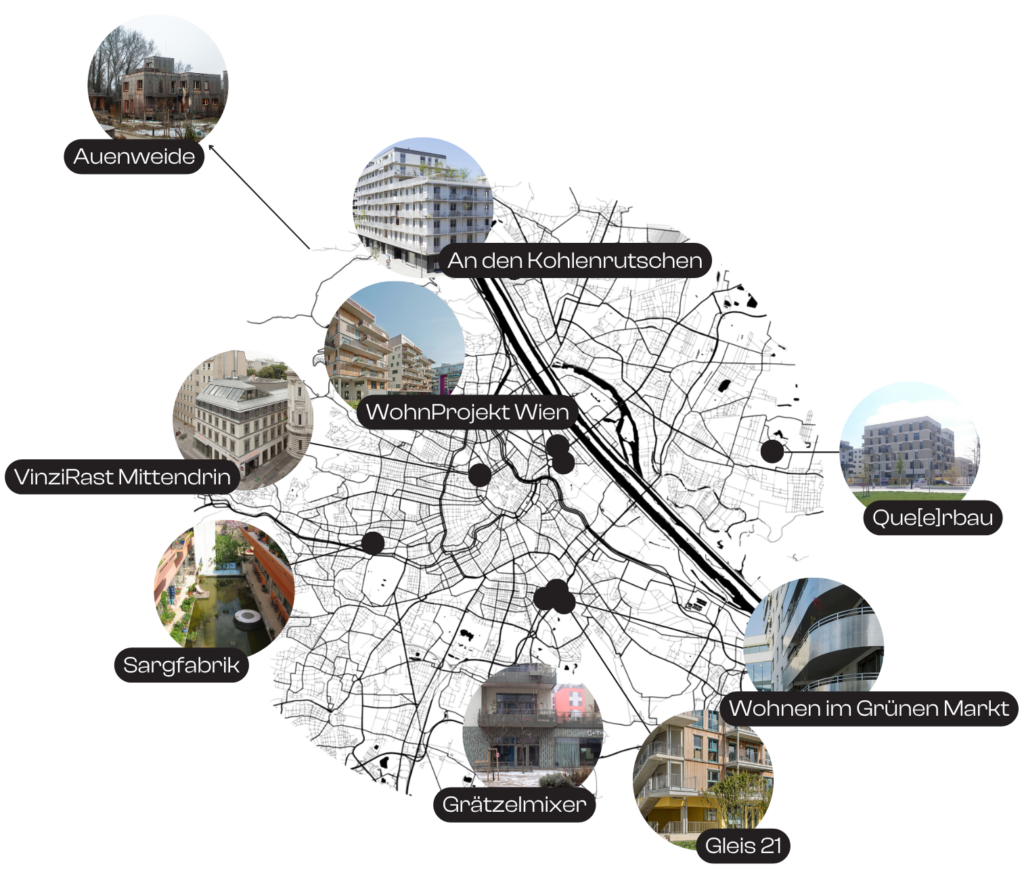
When our tours began, one of the first questions that kept coming up was unexpectedly simple: what do you know about Vienna’s housing policy? The first time I heard it, I wasn’t sure how to answer. I had come to see buildings, communities, ways of living…not policy. But as the question repeated itself, it started to feel less like background information and more like a missing piece. Something you had to understand if you wanted to make sense of what you were seeing.
To understand cohousing in Vienna, you first need to understand something about how the city is being built. For nearly a century of Social democratic governance, Vienna has maintained a strong commitment to social housing. But what makes Vienna’s approach interesting is not just the scale of it, but the logic behind.
In many European cities, social housing became concentrated in specific areas, which over time turned into isolated pockets of poverty. Vienna chose a different path. Instead of concentrating, it scattered social and community-oriented housing projects throughout the city, placing them in expensive central districts as well as peripheral ones, preventing the kind of spatial segregation that has defined social housing elsewhere. Walking through Vienna, you don’t always know which buildings are subsidised and which are not. And that, I began to understand, is exactly the point.
At some stage, the city seems to have asked a different question: not just how to provide housing, but how to shape everyday life through it. How to create neighbourhoods where people might actually know each other, where life does not end at the apartment door.
Cohousing, in that context, is not treated as an alternative lifestyle experiment. It becomes a tool. The city created systems where organised groups could apply for land based not on price, but on what they were proposing to contribute to the neighbourhood. So, Vienna’s cohousing projects are not alternative experiments, but part of a broader vision of what urban life could look like.
“It’s not to fund cohousing because of cohousing. It’s because they saw it as a tool to build neighbourhoods and real communities.” – Markus Spitzer, founder of Auenweide
But even for Vienna the journey was not always smooth, the city learned through early failures that building shared spaces is not the same as building community. There were projects where developers created beautiful communal rooms and discovered that people who didn’t know each other, who had no part in designing the space, would fill it with the furniture they didn’t need in their apartments, start to argue about how it should be used, and eventually stop using it at all. What the city understood was that the built environment alone cannot create community. The community must come first, and then the building follows.
But knowing the city’s role only answered part of my curiosity. What I really wanted to understand was how these communities actually come to being. Listening to our guides, I realised that almost every project began in a surprisingly similar way. It usually started not with a large group, but with just a few people — sometimes two or three, sometimes five — who shared a vision and were willing to invest enormous energy making it real.
One of the most striking examples is Sargfabrik, often described as a pioneering cohousing project in Vienna. Its story began in the 1980s, when a group of students, influenced by feminist and peace movements, started imagining a different way of living. They had no model to follow. Only dissatisfaction with the housing market and a shared idea that things could be done differently. They searched the city for a space until they found an abandoned coffin factory. Years later, after navigating permits, financing, and countless uncertainties, they moved in.
“We called it a project – not a house, a project … and we would have been grateful if there would have been someone we could lean on. We had to invent everything. And it was very exhausting too.”
– Gerda Ehs, founding member of Sargfabrik
Listening to Gerda Ehs, I kept thinking about the sheer persistence that must have taken. There was no clear path, everything had to be invented. And yet, nearly forty years later, many of them are still there. What Sargfabrik made possible for everyone who came after was an inspirational model to lean on. But the determination had to be each founding community’s own.
The founding group’s vision process is the moment where the character of the community is established. Some groups centre on ecological principles; others on cultural programming or solidarity with people priced out of the housing market. These visions become the practical commitments that shape everything from the building’s architecture to the texture of everyday life. But vision alone is not enough. The founders are not only dreamers, they are people capable of doing all the necessary steps. It was no coincidence that in the initial groups of every project I heard about, there was always someone who could mediate, someone who understood architecture, someone with previous experience of cohousing. The determination together with knowledge and skills is what distinguishes projects that succeed from those that don’t.
When Markus Spitzer, founder of Auenweide, was sharing with us how the community in his project was built, he told us something quite important. While having a network of like-minded people around he didn’t let them fill out long questionnaires or go through deep interviews examining their motivation, he simply raised a single question that has been fundamental to him.
“I only asked people if they have a similar idea of how to handle conflict. I only had that one criteria.” – Markus Spitzer, Auenweide
I found this quietly wise. Heinz Feldmann, founding member of WohnProjekt Wien, described the essential importance of communication. The most work in the early meetings was not planning the building, but teaching the people in the group how to speak to each other: how to talk on eye level, how to actually listen.
“So after a few meetings, after a few months, I had the feeling it’s the right critical mass to really get going now.”
– Heinz Feldmann, founding member of WohnProjekt Wien
But knowing who founded these communities only answered part of my curiosity. What I really wanted to understand was what happens next, what it actually feels like to work on building something together before you even move in.
If the founding group establishes the spirit of the project, the co-design process is where that spirit gets embedded into the building itself. And this was, honestly, the part of the whole journey that interested me the most.
The most unorthodox and very interesting approach was chosen by the Sargfabrik community when they were deciding upon the bathhouse creation. When the founding group was about to decide whether they wanted a bathhouse, knowing it would be expensive and would require the whole group’s commitment, they brought in an artist, Gustav Deutsch, who designed a four-part process. In the first session, he built a wooden octagon in a cold February garden, gathered twenty people inside, heated water over a fire, and had everyone wash their feet while talking one-to-one about what bathing meant to them — their memories of it, their traditions, their associations. In the second session, the whole group took a day trip together to the Gellért Baths in Budapest. In the third, they visited one of Vienna’s old working-class bathhouses. In the fourth, they built and spent time in a sweat hut together. Only then, after four days of this, were they ready to decide.
…
You can explore more on his design approach in this article:
…
The idea was that you cannot vote meaningfully on what you have not been able to picture. This thinking has since become much more deliberate. Bruno Sandbichler, the architect of Wohnen im Grünen Markt, one of Vienna’s newer projects, described how much the practice had developed over the years.
“Before, we didn’t have the techniques, the tools… Now we know much more about how you organise, how decisions can be made… Many architects want to be the boss of everything. But if you discuss with more people, you get more requests, more thoughts. You know exactly what you had and why.” He added the most interesting thing he’d learned from working this way: “The most astonishing thing for me was that the people don’t want very special things. They want very normal apartments with bedrooms, and a kitchen with a dining room. And they don’t want the lofts with open showers. Architects are dreaming of that, but not the people.”- Bruno Sandbichler, Wohnen im Grünen Markt
Katharina Urbanek, co-architect and resident of An den Kohlenrutschen, described the process from her own perspective as that from the beginning, the group agreed that the architects would propose certain design steps and sometimes several variants of a solution, providing residents with as much information as possible about the alternatives. The residents then discussed the pros and cons amongst themselves in smaller groups, without the architects present.This created what she called a mood picture showing a sense of the group’s tendency upon which the architects could base further development. The residents were never simply asked „do you want this or that?” and that, she felt, was important for the group dynamics.
..
You can explore more on her architectural philosophy in this interview:
…
At first, it is easy to romanticise this process.
A group of people comes together, shares a vision, designs a building, and moves in. From a distance, it can look almost seamless, as if shared intention is enough to carry everything forward.
But the more I listened, the more I began to understand that conflict is not an interruption to the process. It is the process. One of the projects we visited had spent years circling around what sounded, at first, like a technical question: should rent be calculated strictly per square meter, or adjusted based on things like floor level, sunlight, orientation? On paper, it’s a practical issue. In reality, it became something else entirely. People had different ideas of what was fair. And those ideas were not abstract, they were tied to how each person imagined their future in the building, what they could afford, what they felt they deserved. The architects tried to respond spatially, designing lower floors with higher ceilings and larger windows, attempting to balance out the differences. But even then, the disagreement didn’t fully settle. In the end, two families, who were deeply invested in the question, decided to leave and start their own project.
When I first heard that, it sounded like failure. But the way it was described to us, it wasn’t. It was simply the process reaching its natural conclusion. Not every group can hold together through every disagreement. And sometimes, separating is the only way forward.
Markus Spitzer framed it even more directly when we spoke about these moments. He described how discussions, especially around things like money, tend to surface something deeper than the topic itself.
“If we talk about community, we always get in contact with old wounds we have.” – Markus Spitzer from Auenweide
I remember that line very clearly. Because these conflicts are not just about rent models or design decisions. They are about everything people bring with them like their histories, their fears, their habits of dealing with others. And there is no way around that. You either go through it, he said, or you don’t. And if you don’t, then the project doesn’t really happen, or the group doesn’t stay together.
What struck me most was that, by the time people actually move into these buildings, they have already been through months, sometimes years, of this kind of process. They have argued, negotiated, disagreed, and, in some cases, watched others leave. They arrive not as strangers, but as people who have already tested what it means to live alongside each other. In a way, they have already started living together long before the building is finished.
The process of talking and thinking together doesn’t end when the building is built, it just changes shape. Now it’s not about walls, tile colours and finances, but about how to navigate life together. Each project has a slightly different system, but all of them have some form of shared governance, whether through working groups, circles, or simply shared responsibility for common spaces. And these structures, it turns out, are one of the main ways deep individual connections get built.
At WohnProjekt Wien, the structure is explicit: sociocratic circles, each responsible for a specific shared space or function like the community kitchen, the workshop, the garden, the mobility group managing shared cargo bikes. Each circle sets its own rules. The community contribution is around a hundred and ten hours per person per year. At Que[e]rbau, on the contrary, the approach is far more relaxed, resisting mandatory structures. But there is Yella, Que[e]rbau’s community bar and event space, which needs to generate income to survive. Everyone knows this. So everyone contributes — not on a rota, not because a rule demands it, but because they share the same goal.
Markus Spitzer put the underlying principle in a way I keep thinking about:
“People connect through responsibility for the house. They don’t connect because I tell them to go to a workshop to connect. If they have common responsibilities for the common spaces, they have to talk to each other about how to use them and how to finance them. And while talking about that, they get to know each other. That’s the way we do community building.”
– Markus Spitzer, Auenweide
No matter what system you choose to follow, there is a need for a culture of shared care to go alongside it. Markus Spitzer illustrated this through the example of the shared workshop when describing going into it the way someone might describe entering a place they deeply appreciate.
“Wow, I have this here. Everyone has their own flat. But I have this too. So when I go down, I leave it better than I had it before. When people have this in their minds, in their hearts — then they will go down and pick up what the last person left. And then it will start to work.”
– Markus Spitzer, Auenweide
Bruno Sandbichler witnessed the same thing from a different angle: once people move into normal housing, he said, they start to let it deteriorate. In cohousing, they start to make it better.
But any system, however well designed, has to account for the fact that people’s energy and capacity to participate will always be uneven. What Gerda Ehs at Sargfabrik shared with us reframed this for me entirely. She described a resident, who others might look at now and think: “why is he even here? He does nothing. And yet the people who know the history know: we are not sure this project would exist without him. His energy was thirty years ago.”
Some people have a consistently high level of engagement all their lives. Others have periods of intensity followed by long stretches of near-absence. People get sick, take demanding jobs, have children, go through difficult times. In a project of two hundred people, this unevenness is not a flaw, it is kind of a structural necessity. If every resident gave maximum energy simultaneously, the system would implode.
“I think it should have a place for those who have a very low level of activity. Because those who don’t have the energy to be active have good reasons.”
– Gerda Ehs, Sargfabrik
There was something so generous and mature in that. It completely changed how I understood what participating in a place like this would even mean. All of this — the governance, the circles, the shared responsibility — it sounds quite serious when you describe it. But on an ordinary Tuesday, none of it looks like governance at all.
For all the talk of governance structures, working groups, and decision-making processes, I kept wondering what any of this actually looks like on an ordinary day.
Not in a meeting. Not in a conflict. Just… life. And the answer, when it came, was surprisingly simple.
It looks like bumping into someone by the bins and staying there a little longer than you meant to. It looks like stepping out onto a shared balcony and finding yourself in conversation without having planned it. It looks like going downstairs without a clear reason, just a vague sense that someone might be there…And usually, someone is.
The more stories I heard, the more the image began to shift in my mind. Less like a housing model, more like something that felt oddly familiar, a kind of urban village, but without the parts that usually make that word feel heavy. Andreas Konecny described it through someone else’s experience: for his friend, the architect Roland Hampl, the building had simply become a replacement for the village he grew up in. Not an experiment. Not something unusual. Just… normal.
When keeping listening to more stories about the everyday moments the picture actually was getting contours of the village vibe even more. Markus Spitzer shared with us a story about a single mother and professional violinist at WohnProjekt Wien who hadn’t been able to practise at home because her son felt the violin was competing with him for her attention. From the first day she moved into the cohousing building, her son ran through the communal spaces from person to person, absorbed by the life of the house. “When she told that story,” Markus said, “he was crying.” It is such a small, specific change. And yet it says so much about what these places make possible.
In Que[e]rbau, a resident had been hospitalized in serious condition. Every day, he sent a message to the community group chat, updating people on how he was doing. Sometimes cohousing means to know that there are people who will read your message, who will answer, who are there in some quiet, consistent way. Sometimes, that is enough.
Katharina Urbanek, the architect who lives at An den Kohlenrutschen, described it with a simplicity that I keep coming back to:
“I find it very freeing. I never have the feeling that I have to leave the apartment on Sundays to be able to breathe. I would not mind going down here in my pajamas if it’s necessary. In general, I would say, I have a positive encounter with everybody.”
None of this sounds extraordinary when you describe it. But over time, these small moments seem to create a different kind of everyday life. A life where you are not constantly anonymous. It began to feel like a kind of expanded home, not in the sense of losing privacy, but in the sense of gaining a wider field of familiarity. A place where you can move through shared spaces with a certain ease, knowing the people around you are not strangers, or at least not entirely. An urban village, maybe. But the one you choose and that difference, the fact that it is chosen, change everything.
Though, as I was about to find out, it is not always that simple. Closer proximity means village density as well as village warmth, and problems arise naturally. As we already know, some conflicts cluster around the intense early period of design and decision-making. Others arrive later, when life changes in ways the community’s founding agreements didn’t anticipate.
One of the most quietly poignant examples: at some projects, a founding commitment is that apartment size should match the number of people actually living in it: no one should occupy more space than they need. Most people can agree to this in the abstract. It becomes considerably harder when you have spent years in one flat building the space around exactly how you want it, choosing the tiles, arranging everything to fit the particular contours of your life, and then your children leave, and the community’s logic says it’s time to move somewhere smaller. I understand that tension viscerally, even just imagining it.
But there are rules and there are humans, and sometimes in these projects before hardly imaginable solutions are born out of complicated situations. Heinz Feldmann described this using the analogy of hardware and software. Hardware is physical modification like moving walls, rerouting electricity. Expensive, often impractical. Software is something else: renegotiating who lives where through conversation, through creative arrangements between neighbours. When giving the examples it felt unimaginable in a normal housing setting like mentioning two families on the same floor whose apartments were designed so that rooms could be exchanged between them: one family had not had children as they had hoped; the other had adopted a child. The room went across the hall for a few years, until the dynamic changed again. In another case, a growing boy slept for two or three years in a spare room next door, walking between the two apartments each evening, because the two families simply talked and agreed it was the most sensible solution.
“What is easier is to change the software to really switch apartments. Because people talk.”
– Heinz Fieldmann, WohnProjekt Wien
Because people talk. It sounds so simple. And in most housing situations, it just doesn’t happen.
Sometimes conflict doesn’t dominate at all because the shared purpose is large enough to put small irritations in perspective. As Gerda Ehs put it: “We are not only living together, we have an enterprise together here. Otherwise we would quarrel about little things. Of course we quarrel about little things. The group too. But we are responsible for a big thing here.”I found that oddly comforting. The quarrelling doesn’t go away. It just gets a larger context.
…
I began this journey with a certain skepticism. Some part of me kept waiting for the catch, for the moment where it would reveal itself as unrealistic or unsustainable.
That moment didn’t really come. That is not to say cohousing is perfect. These projects have conflicts, difficult years, and people who leave. And Vienna’s model cannot simply be transplanted elsewhere without considering the conditions that made it possible.
But something shifted. The people I met were not living in utopias. They were living in places they had shaped together with all the complexity that involved. And many of them stayed for decades… like Gerda Ehs, who has lived in Sargfabrik for nearly thirty years, and was asked what this kind of living had given her that nothing else could have.
“Being at the inside of such a process. Understanding the aesthetic of architecture. And very personally I’m really grateful my children could grow up here. Not only because it was easy for me as a parent. But because my children had the possibility to experience serious relationships with other adults. It wasn’t always cosy and harmonious. But it was an open-minding experience.” She paused… „We’re in the middle of a big city, but in some aspects it has the character of a village. With the density of the village and surveillance and control. But it’s easier than a real village. Because it’s a free choice. Living here.”
– Gerda Ehs, Sargfabrik
There is a difference between shared walls you did not choose and shared walls you consciously walked toward. Between imposed proximity and chosen community. But the choice comes with the condition. Heinz Feldmann put the condition for that choice plainly, and without any attempt to make it sound easier than it is:
“If you want your home to be your castle, and you want to decide when you cut the grass in the yard then you won’t be happy here. You have to be willing and able to get in touch with all the others, and also listen to some opinions you think might be a bit off. That is the price of all of this.”
– Heinz Feldmann, WohnProjekt Wien
Cohousing is certainly not for everyone, but for some it can be a wonderful opportunity to spend life just as they wished to, a way of living where you are not alone unless you want to be.
The great witnesses to this are second-generation cohousing residents who decide to come back. “I grew up outside of Vienna in this kind of cohousing project, so for me when I moved in it felt like finally the way it should be. It has to be. I was really happy and had the feeling, okay, now it’s right again.”– Katharina Urbanek, An den Kohlenrutschen
So when answering the question wherever it is for me. I think I have certainly more food for thought to answer that question for myself now. And maybe you do as well.
